
Living with Aphantasia in a World Obsessed with Visuals!
For most of my life, I thought “visualise” was just a fancy word for think about it really hard while your brain plays a podcast!
People would say, “Just picture it in your mind!” and I’d nod, enthusiastically …. but in my head I’d be replaying words, facts, voices, the vibe of it all. A kind of audio-theatre with bonus feelings. I assumed this was how everyone experienced imagination. That the whole “mind’s eye” thing was a metaphor, like when someone says they’re green with envy but isn’t actually turning into Shrek.
Then …. one day last year, I found out people actually “see” things in their minds ….
… Like, properly see ….
Colours …. Faces…… Scenes….. Whole cinematic experiences unfolding behind their eyeballs like a private IMAX!!!!!
… And I? …..
Well, I have… nothing. Just narration. No visuals. No slideshow. My brain is all content, no screen!
This blog explores what it’s like in my head (I apologise in advance!) and the weird world of Aphantasia, the best I can describe it anyway!
So… What Is Aphantasia?
Aphantasia is a fancy name for something quite simple …. I can’t see pictures in my head.
None. Nothing. Zero!
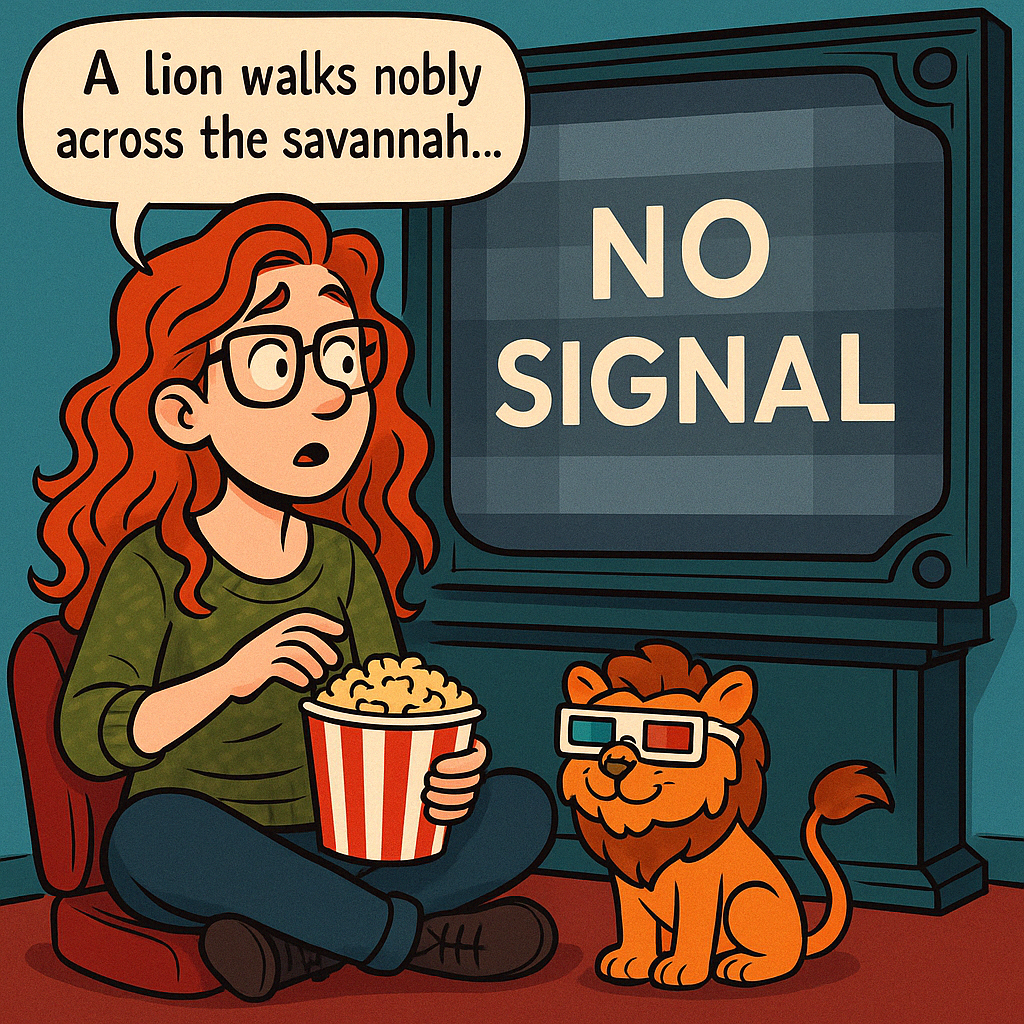
If you say “close your eyes and imagine a lion,” you’ll probably conjure up a shaggy golden mane, swishing tail, majestic stare. Maybe it’s yawning. Maybe it’s doing that slow-motion thing lions do in nature documentaries.
Me? I close my eyes and get… darkness. Maybe the word “lion” in my own voice. Maybe the concept of lion-ness. But that’s it. My brain’s idea of visualising is like one of those audio descriptions on TV, “a large yellow beast with a long tail and mane, walks across the savannah, mane rippling in the breeze…” That’s what happens inside my head. A literal inner monologue. No fluffy visuals. Just words. Sometimes sound effects. Definitely vibes.
And weirdly, I didn’t know this wasn’t how everyone’s brain worked until last year.
See, I always thought “visualise” was a metaphor. So when people said things like “picture your happy place” or “imagine a beach,” I just replayed the idea in my head using sound and language. I’d use constructs from things I knew or had seen as building blocks for the audio, and describe it to myself. I assumed everyone did the same.
Then one day, a friend casually said, “Did you know some people actually see pictures in their minds?”
And I was like: …Excuse me?
Turns out, that friend had just found out they had aphantasia … and by telling me, they helped me realise I had it too. Which is how this whole thing usually happens …. It filters down one discovery at a time, like a weird brain-based pyramid scheme of revelation!
Aphantasia is a neurological variation where people can’t form mental images. In fact, apparently, aphantasia wasn’t formally named until 2015, when Professor Adam Zeman and his team at the gave it a label after a patient mentioned losing the ability to picture things in his mind. (https://www.scientificamerican.com/article/when-the-minds-eye-is-blind1/)
And according to Zeman’s 2020 study, less than 3% of people of his participants had some form of aphantasia. (https://doi.org/10.1016/j.cortex.2020.04.003). These figures are similar across the literature I’ve seen where estimates tend to be under 4% of people. However, given how difficult it is to know how you see isn’t how others see in their mind, will we ever really know!
Interestingly the study showed it was shown to be highly associated with scientific and mathematical occupations! Just like being neurodiverse … hey wait I’m starting to see a pattern!
Faces and Feelings
One of the stranger things about aphantasia is how much I rely on everything except your face to remember who you are!
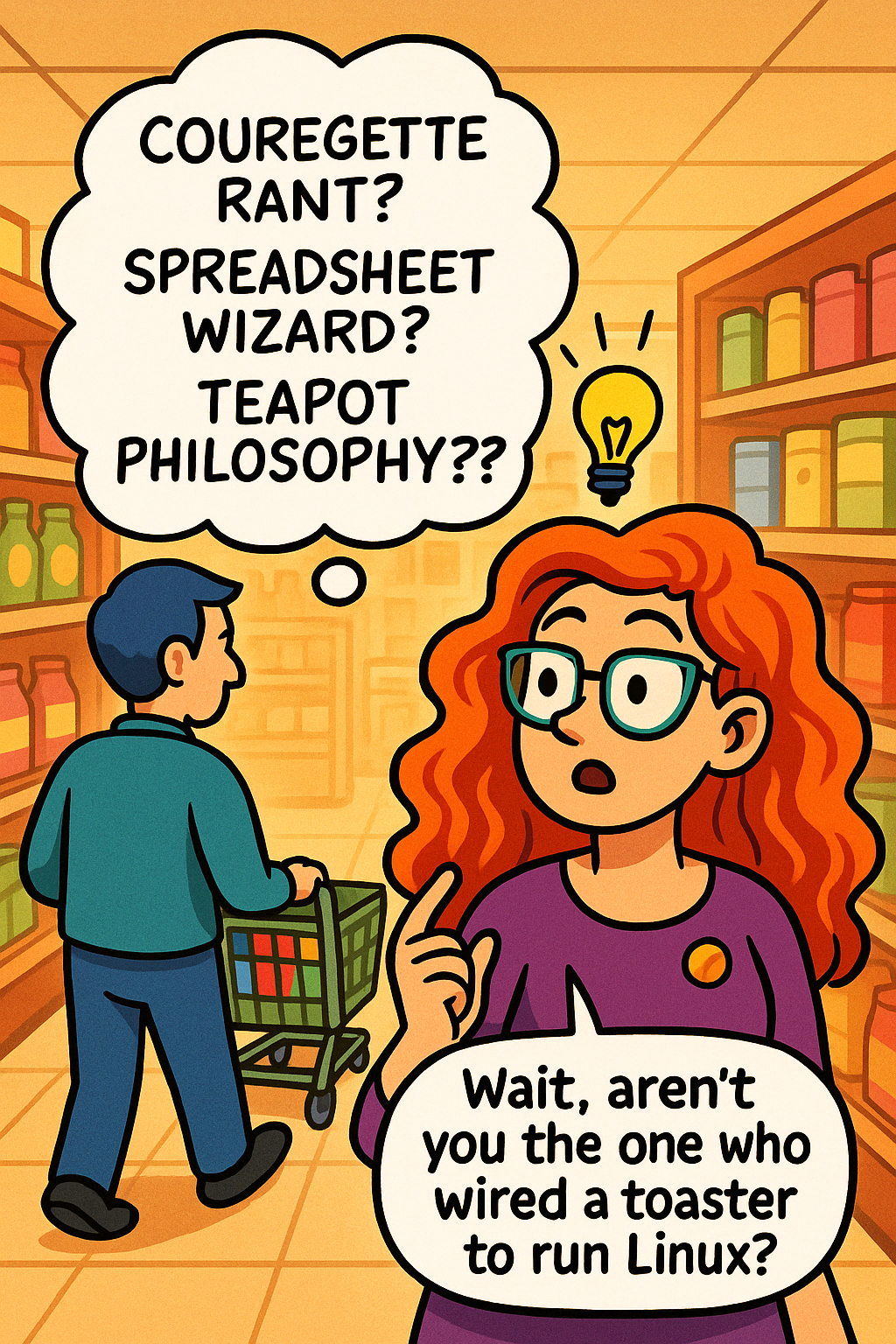
If when I see you, you’re wearing a hoodie instead of the usual lab coat, I might completely blank you. Move you from a lecture theatre to a supermarket and I am no longer confident we’ve ever met. You could be a close colleague or someone I’ve shared ten years of office snacks with, but unless the context is familiar, I might spend several seconds trying to work out whether I know you, taught you, or had a passionate debate with you about cable management!!
This isn’t because I’m rude or distracted. It’s because my brain doesn’t store your face like a visual file. Instead, it logs you emotionally and aurally. I don’t remember “Charles with the briefcase” I remember “Charles who brought biscuits to the first lecture and stayed behind to help me carry chairs.” That’s how I work. Voices. Vibes. Verbs. (I’d like to be VERY clear, that’s not what I remember Charles for!)
It’s not quite face blindness, although some people with aphantasia apparently also have that. For me, it’s more like my memory decided to skip the visuals entirely and focus on what really matters. What you said. What you made me feel like, your vibe! Whether you also get overly excited about new labels on evidence bags.
And honestly, I quite like it. It means I connect with people through what they bring to the world, not what they look like in a photo. I remember kindness. I remember chaos. I remember someone once describing themselves as “an algorithm with boundary issues” and I have never let that go.
So if you see me staring blankly for a moment before going, “Wait! Aren’t you the one who said you loved having me here” please take it as a compliment. Your face may fade. Your impression does not.
Grief and Ghosts
Grief is strange at the best of times. With aphantasia, it comes with an extra sting.
Take my gran. The minute I see a photo, I know that’s her. That’s Mrs B. That’s the woman who made me feel seen, who gave me biscuits when life was rubbish, who could say more with one raised eyebrow than most people manage in a three-hour PowerPoint.
But without a photo, I can’t summon her image. I can’t close my eyes and picture her face. She’s not there in my mind’s eye, because I don’t have one.
What I do have is her voice. Her rhythm. The way she’d say my name when I’d done something clever, or daft, or both. I know exactly how she’d respond to things. I know the feeling of being in her kitchen. I know how I’d feel if she was here now. But I can’t see her. And that, in moments of grief, feels like such a cruel omission.
It’s the same with every person I’ve lost. I don’t carry their image with me. I carry their presence. The echo of their language. The way they made me feel when I was near them. And sometimes, that’s enough. But sometimes, especially when the world is quiet and I wish I could look back at someone I love, the darkness behind my eyelids feels just that bit deeper.
Grief becomes less about looking at someone in your mind, and more about holding on to their impact. It’s a scrapbook made of sound and soul rather than snapshots. And while that can be beautiful, it can also feel like you’re grieving without a photograph, even when the photo is right there in front of you.
The Nearly-There Visualising of People
When your brain doesn’t make pictures, but somehow, a few people still leave shadows
This doesn’t happen with everyone. In fact, it’s only ever happened with a handful of people in my entire life.
There are just a few souls who’ve left such a deep imprint that, even without pictures, they somehow linger. Not in a spooky way. Not in a way I can explain. Just a feeling that they’re there. A sense of them in the space between thoughts. Like they’ve carved out a little pocket in my brain and curled up in it without needing to be looked at.
And I’ll be honest. Sometimes I only realise how much someone means to me because I start feeling them like that. I’ll be in the middle of something completely unrelated, and suddenly, there they are. Not as a face. Just as a warmth. A memory of laughter. The echo of a sentence. A presence I didn’t invite in, but don’t really want to leave either.
It’s rare. It’s quiet. It’s never visual. But it’s real.
And if given I can disappear for ages, or seem cold when out of sight, you’ve ever found yourself wondering whether I think of you, or whether you ever drift across my mind when I’m busy with other things… maybe this is your answer.
You might not live in my mind’s eye. But that doesn’t mean you’re not there.
Dreams: The Bootleg Cinema of My Brain
When your brain forgets it can’t do pictures
Every so often, my brain throws me a curveball. I’ll wake up from a dream and swear I saw things. Proper visual things. Places. People. Colours. Movement. It’s vivid and oddly beautiful, and for a split second, I think, maybe this is what everyone else gets all the time.
But the moment passes. The details dissolve. And I’m left wondering whether I actually saw anything at all, or whether the emotions were just so intense that my brain filled in the blanks. Like a bootleg cinema experience where the projector’s broken but the soundtrack is banging.
I’ll wake up and think, I saw their face. I remember the colour of the room. I know the shape of that impossible building. But then I try to hold on to it, and it slips away. I can’t replay it. I can’t focus the lens. It’s all feeling and fuzz.
It’s hard to describe, because it feels like remembering something I was never really allowed to see. I don’t know if those dreams are made of images, or if they’re just emotional echoes wearing fancy costumes.
What I do know is that they stay with me. Not as pictures, but as residue. I remember how it felt to be there. I remember the way it carried me through the day. I remember waking up and thinking, that meant something, even if I can’t see it now.
And maybe that’s the closest I’ll ever get to dreaming in pictures … But honestly, it’s enough.
Digital Forensics – What My Brain Doesn’t See, But Can’t Forget
People assume that working in digital forensics means I must carry horrific images around with me. And to be fair, I do see horrific things. I see cruelty. I see pain. I see the worst of what people do to each other, often in pixel-perfect clarity.
And yes, it stays with me. But not the visuals themselves. What lingers is the description. The feeling in the moment I first encountered it. The sick weight of realising what I was looking at. The physical reaction. The sense of helplessness. I don’t replay the image, but I absolutely relive the impact.
What really sticks is everything else. The things around the edges. The words, The voices, The Patterns, The uncertainty. The tiny clues in text that hint at someone being afraid or someone being overlooked. A message sent too late. A sentence someone should never have had to write. An error in a log file that changes the whole story.
And I think aphantasia might play a part in that. I don’t hold on to images, because I never really see them in my mind. But I do hold on to sounds. I hold on to written words. I hold on to timing, and tone, and the silence between two lines of chat. The feelings I felt as I looked through the data, as I completed the investigation. That’s the part that gets to me. That’s the part that lingers long after the screen is off.
It’s made me think a lot about the mental health crisis in this field. We talk about the horror of the content, and yes, that matters. But for some of us, it’s not the visuals that do the damage. It’s the emotional weight of context. It’s piecing together someone’s life through fragments and knowing, at the end of it, that justice may still not come.
I don’t think I’m immune to the impact. No one is. But I do think the way I experience the world gives me a slightly different lens. A lens built not from imagery, but from meaning. And maybe that helps me. Maybe it also explains why I investigate the way I do …. slow, deliberate, often led by patterns in language or rhythm, rather than what I can see.
It’s not that I feel less. It’s that I feel differently. And in this line of work, that difference might just be what keeps me going.
Give Me Snow Over Scenery Any Day
People often rave about the visual beauty of a place. The view. The colours. The sunsets. And I get it, I really do. I can tell you which photo is more appealing, which mountain looks more majestic, which fjord is the fjordiest.
But once I’ve seen it, that’s it. My brain doesn’t store the image. It’s like looking through a window with no screenshot button. It’s pleasant in the moment, but it rarely sticks.
What does stay with me is everything else.
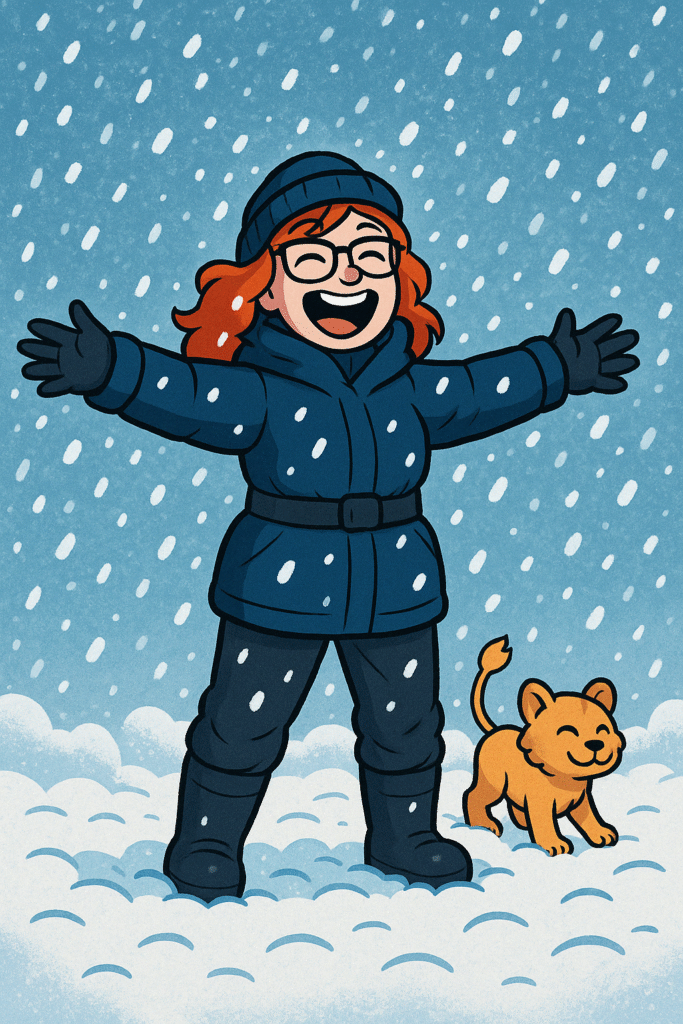
Take northern Norway in 2019. It was snowing. Properly snowing. Not the UK kind where three flakes fall and someone declares a snow day. This was deep, crisp, powdery, enveloping snow. I was wrapped up in layers of ridiculous thermal gear, walking through silence that made my ears buzz, the cold air biting and refreshing at the same time.
And I loved it. Not because it was beautiful, though I am sure it was, but because it was immersive. I remember the crunch of snow underfoot. The way it hit my cheeks. The contrast of freezing air and the warmth of my jacket. The smell of winter. The way it felt like the world had gone quiet so I could hear my own thoughts more clearly. I remember giggling. Actual out-loud joy. I stayed out in it for ages, getting covered in snow and not caring one bit, because I was warm and comfortable and the whole thing felt magical. It was like being inside a sensory fairytale that made me grin from the inside out.
That’s the stuff my brain holds on to.
The sensory detail. The full-body experience. The emotional atmosphere of a place.
It made me think about other places I’ve always wanted to visit. I finally made it to Egypt in 2022, after years of dreaming about it. And it was amazing. The history, the sights, the sheer scale of everything was mind-blowing. I had a brilliant trip. But it didn’t land the same way. I saw it. I appreciated it. I’m really glad I went. But I wouldn’t rush back. It didn’t leave that sensory imprint. No emotional hook. No giggles, No sensory / vibe feelings.
Norway, though? I’d go back in a heartbeat.
The places I return to are the ones that leave a mark beyond the visual. The ones where I felt safe, joyful, silly, curious. The ones that let me feel fully present, not just impressed.
So yes, you can keep your postcard-perfect mountain views. Give me snow in my boots and warm mittens on my hands any day.
Life, Love, and the Sensory Archive
My brain doesn’t do photos. It doesn’t store faces. It can’t replay sunsets or pull up mental montages of holidays or hugs. I don’t have a mental scrapbook of birthdays or adventures or special events. No home movies. No visual flashbacks.
And for a while, I thought that made me different in a not-great way. Like I was missing a piece of the emotional memory puzzle.
But what I’ve come to realise is this. I do remember love. Just not in the way people expect.
Romantic love, for me, isn’t about remembering how someone looks across the table. It’s in the sound of their voice when they’re being thoughtful. It’s the warmth of their hand in mine. It’s the way they make me laugh when I least expect it. I won’t carry a picture of your face in my head, but I will carry the way you made me feel when we danced in the kitchen or geeked out about something deeply ridiculous at 2am.
With family, it’s the same. I can’t picture my gran’s face unless I’m looking at a photograph. But I know her voice. I know exactly how it felt to be hugged by her, how she said my name, how she made me feel safe even when the world didn’t. That’s what I carry with me. Not her image. Her essence.
And when it comes to friendship, I might forget what you were wearing or where exactly we were, but I will absolutely remember the energy of the conversation. The snack you brought to cheer me up. The way you made me feel seen on a hard day. I might not be able to picture our time together, but if you’ve made it into the sensory archive, you are firmly in the category of treasured.
But this goes both ways. If someone made me feel small, or scared, or unwanted, that’s in there too. Not your face, not the moment as a mental movie, but the feeling of being hurt. The tone you used. The silence when you looked away. The nervous energy I carried home. And because my memory is built from emotion, not pictures, it can take a long time to let that go. The hurt lives in my body, in my breath, in my thoughts, not just in a flash of recall.
Maybe that’s why I love the way I do. Maybe that’s why I live life with all the Disney-hearted enthusiasm I’ve got. Big emotions. Big loyalty. Big grief when it ends. Because when something feels right, it leaves a mark that lasts. And when it doesn’t, it takes a lot to scrub it from the archive.
The people who stick in my memory are the ones who make an emotional or sensory impact. You have to have a presence. A feeling. A vibe. And once you’re there, you’re really there.
Those memories mean the world. They’re not snapshots. They’re impressions. They’re deeply personal, rooted in joy or comfort or connection …. or sometimes, pain.
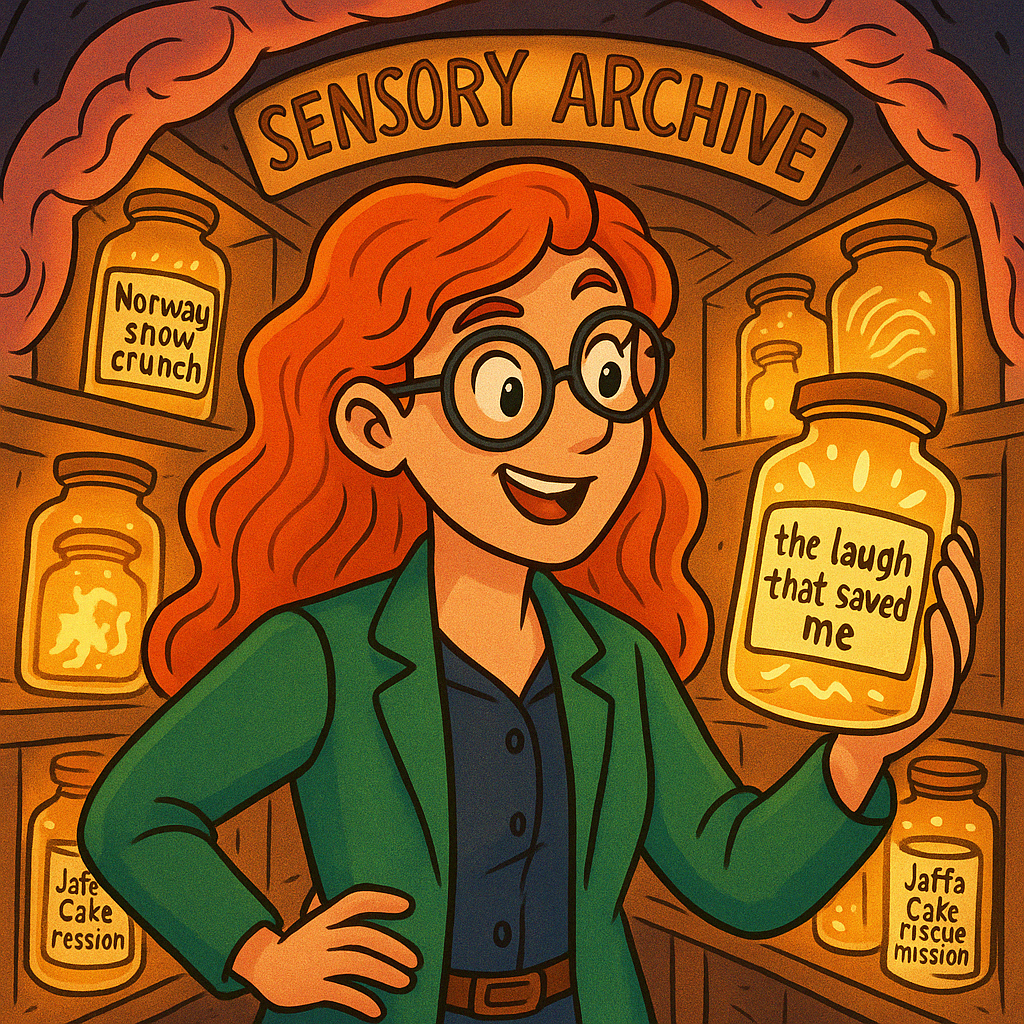
I might not have a mind’s eye. But I have something just as rich. I have a sensory archive. A vault of meaning built from sound, touch, timing, emotion, and the occasional hex editor.
And honestly, I wouldn’t trade that for a thousand crystal-clear images!!!!!!!
Wanna Know More? Start Here!
Resources for the curiously wired and quietly wondering
If you’re sitting there thinking, hang on a minute, I don’t see pictures in my head either… or maybe you’re just curious about how all this works, here’s a small collection of useful starting points:
What is aphantasia?
A great intro from the folks who coined the term
https://www.scientificamerican.com/article/when-the-minds-eye-is-blind1/
How common is it?
Zeman et al. (2020) found aphantasia is uncommon!
https://doi.org/10.1016/j.cortex.2020.04.003
Take the VVIQ (Vividness of Visual Imagery Questionnaire)
This is the tool often used in research to help people explore how vivid their mental imagery is
https://aphantasia.com/vviq/
Visit the Aphantasia Network
A brilliant hub of stories, research, and community connections
https://aphantasia.com/
Watch a quick explainer
This short BBC Ideas video gives a lovely overview of what aphantasia feels like
https://www.youtube.com/watch?v=fNxcWpgq-q4
And finally, whether you’re a picture-thinker, a word-weaver, a sensory sponge, or still figuring it out… there’s no wrong way to imagine … Just maybe, your imagination works in a way the world hasn’t fully understood yet!!