
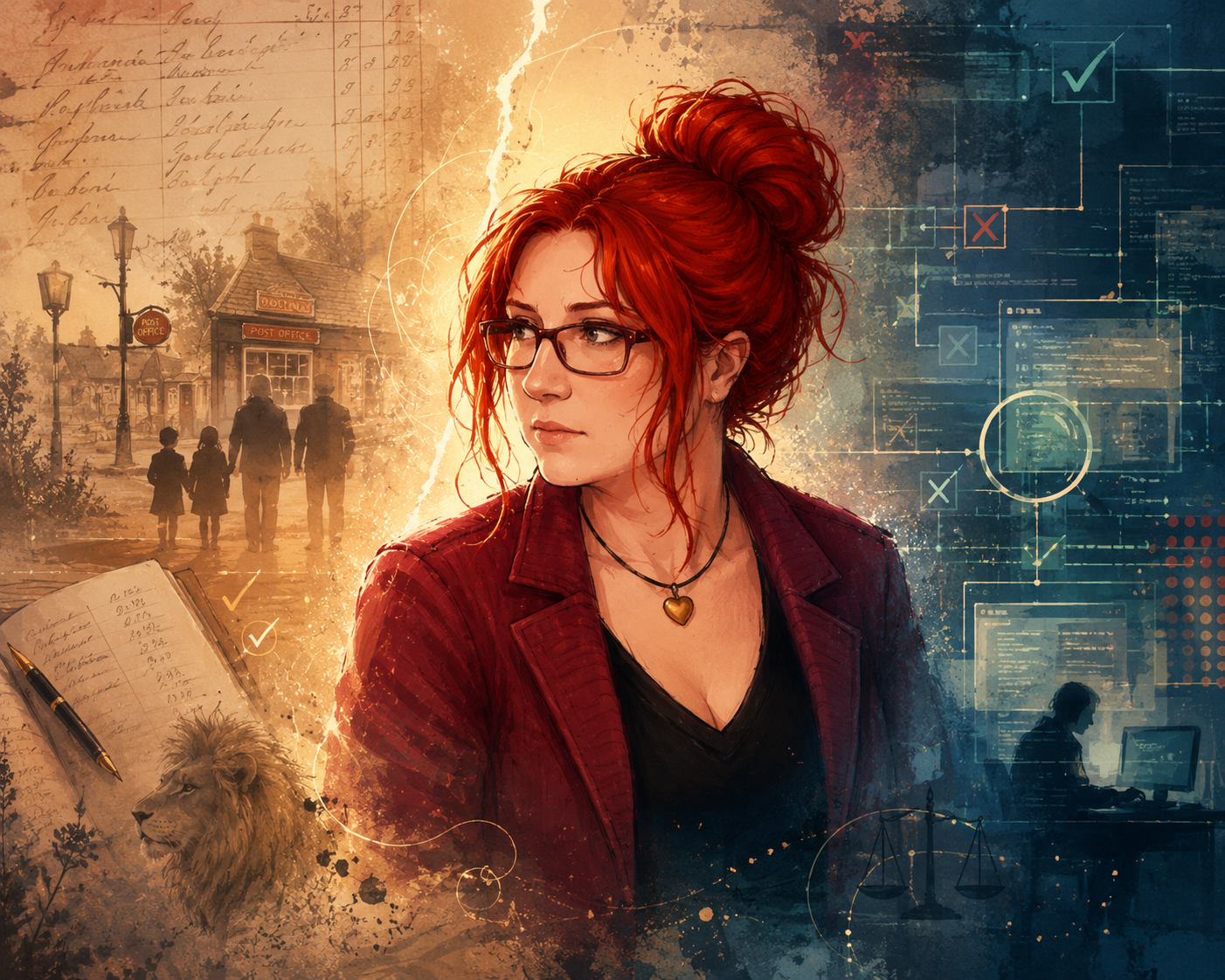
I’m sharing this with the knowledge and support of those close to me (living) who are involved. This piece isn’t about them, though. It’s about what happens when we stop asking questions of the systems we trust.
The Bit Where I Explain What I Do (Stay With Me, It’s Relevant)
I teach my students the importance of contextualisation in digital forensics…. the discipline of never accepting what a system appears to show without first asking what else might explain it. We look at artefacts, the device, and user behaviour, and then we look again, because the first reading is rarely the complete one. We test the obvious explanation against the alternatives! We ask whether the tool that produced the output was configured correctly, whether it was the right tool for the job, whether a software update might have changed its behaviour since it was last properly validated. We trace the chain from the raw data to the conclusion because somewhere along that chain a human made a decision, and humans… well …. Humans are fallible! They built the systems, they configure the tools, they interpret the outputs, they write the reports… then other humans read those reports and decide what they mean.
This is not a reason to distrust technology. It is a reason to understand it properly…. to treat the output of a digital system with exactly the same rigour we would apply to any other witness …. Cross-examination …. Challenge …. The right to ask what else could explain this. A computer, for all its apparent certainty, is not neutral. It is a reflection of every human decision that went into building it, and humans, as a rule, are not infallible.
I know this professionally. I also know it personally, in a way I don’t usually talk about. After much reflection, and with the knowledge of those involved, I think it’s time I did.
The Before, the After, and the Bit in the Middle I Never Mention
There are two versions of my dad that I talk about. The before version: a senior figure in banking, back when banking was a deeply human discipline, built on experience and judgement and the kind of meticulous attention to figures that you develop over decades, not months. He understood money the way people understood money before machines did most of the thinking…. as a living thing, with patterns and weight and story. He kept his records by hand, line by line, exactly as he had always done. He was fiercely proud of his family, protective in the way that some parents are without ever making it a performance, and he gave everything he had without making it a speech. We disagreed, as children and parents do…. probably on most of the decisions I made in my youth…. yet the support never wavered.
Then there’s the after version …. Holiday parks …. Finance roles in different places, quieter and further from where he’d been …. A life rebuilt from whatever remained after the middle.
I never talk about the middle ….
What a Child Knows (Which Is More Than You Think)
I was eight when we left Nottingham. When my parents bought a rural post office and shop in a small Norfolk village. If you haven’t grown up in that kind of place, it’s hard to explain what a post office means to a community like that. It isn’t just a service…. It’s the social infrastructure, the place where trust moves as surely as money does, where everyone knows everyone and outsiders are held at a particular kind of distance that is never quite unfriendly but is always noticeable. My parents were outsiders, they worked hard, they were building something for the community and their family.
By the time I was twelve …. it was gone.
Not just the shop …. The home …. The stability …. The sense that the ground beneath us was solid. My parents were interviewed under caution. They were investigated as though they were criminals, on the basis of discrepancies between my father’s handwritten accounts and a computer system whose output nobody independently verified. Nobody sat down with him and traced through the calculations. The same figures were fed back into the same system, produced the same mismatch, and the conclusion reached was that he must be at fault. That money was unaccounted for. A man who had spent his career understanding money at a level that computers weren’t yet capable of replicating was told the machine knew better than he did!
The accusations didn’t stay inside the house. In a place like that, they never do. Without the post office, the shop soon folded, we were stuck in a community who held us accountable and saw us as outsides. It wasn’t home. Alongside this home…. the family who should have been the safety net…. hadn’t believed them …… Grandparents…. Aunts and uncles …. older relatives of all descriptions. The people who should have closed ranks looked at the situation, and supported us, chose the institution instead. An organisation on one side, my parents on the other, and everyone trusted the computer and the Post Office!
There were letters I wasn’t supposed to see, arguments I wasn’t supposed to hear. I saw them anyway, because children always absorb the things that are kept from them…. and spend years afterwards carrying a weight they don’t have the language for. The community, which had held us at a distance from the start, found in the Post Office’s certainty a reason to hold us further still.
With significant losses (house, financial, friends, mental health, family), and everything generally in a mess, instead of moving back to Nottingham, we moved to south Norfolk, somewhere farther from home, and wow was I angry about that!!! Not long after we moved, to this new place where we only had the 5 of us and were cut off from family, a letter arrived at the new address. Unsigned …. It said they knew where we were. My parents brushed it off, at least in front of us. I was easily spooked as a child, and that letter stayed with me for a long time. Thinking about it now, with the understanding of an adult who knows the fuller shape of what was happening, someone somewhere felt that a family who had already lost everything still needed to know they hadn’t been forgotten. That the suspicion was portable …. That it had followed them.
I understood none of the context at the time. I understood the feeling of it…. the way a family changes shape when something invisible is wrong, the way my parents for quite some time said they weren’t hungry, they were just making sure we had food. The fact that so much of my life from 10, my parents went without to make sure we didn’t notice how bad things were, and tried to give us the absolute best life they could, whilst broken, destroyed, and desperately rebuilding their entire lives.
Two Systems….. Same Pattern …. Nobody Checked Either?!
This was not the Horizon system. I want to be clear about that, because it matters enormously (but thank you if you think I’m young enough that it could have been!)
Horizon…. the software at the centre of what has rightly been called the most widespread miscarriage of justice in British legal history, with over 900 subpostmasters wrongfully convicted between 1999 and 2015…. is now the subject of a major statutory public inquiry chaired by Sir Wyn Williams. Volume 1 of the final report was published in July 2025, documenting in forensic detail the scale of human suffering the system caused. The inquiry continues, and its full findings will be significant. You can follow it at postofficehorizoninquiry.org.uk.
What my family encountered was earlier, and in some ways darker for its obscurity. In the mid-1990s, the Post Office was pushing a standalone accounting system called Capture onto subpostmasters, replacing the manual processes that many had used for decades without a single unexplained discrepancy. Capture was developed in-house. It launched in 1992, and went through many different versions between then and 1999. Crucially, the Kroll investigation later found no evidence that the Post Office’s audit, investigations or legal teams ever took into account the known bugs in those versions when pursuing subpostmasters for shortfalls …. The problems were known …. The pursuit continued regardless.
After the Horizon scandal reached public consciousness, Capture users began coming forward with eerily familiar stories. The government commissioned an independent forensic investigation by Kroll Associates, published in September 2024, which concluded there was a reasonable likelihood that Capture had created false accounting shortfalls for which subpostmasters were then blamed, and in some cases prosecuted. The government accepted those findings entirely. The Criminal Cases Review Commission is now reviewing cases. The first Capture case reached the Court of Appeal in 2025. The chapter has not finished being written, and you can read the full Kroll report and the government’s response at gov.uk.
My parents were not part of a named cohort …. There was no public inquiry for them …. No ITV drama …. No moment of collective vindication. They were just wrong, apparently…. quietly, completely, devastatingly wrong…. and the family who should have stood with them chose the institution instead. More devastatingly, by the time the Horizon scandal reached the public consciousness, most of my dad’s family had already died. Meaning they died believing my parents were guilty!
My parents didn’t move home after all this … and looking back why would they? Home had made its choice!
The Wrong University, the Right Accident, and Why Anger Needs an Address
Here is the part I am not ashamed of, though I carried it as misplaced anger for such a long part of my life.
I grew up in south Norfolk with the particular low-level rage of a child who doesn’t know what she’s actually angry about. I missed my grandparents. I missed the extended family I barely saw anymore, the aunts and uncles who had become distant in a way nobody explained. I was teased in Norfolk for sounding like I was from Nottingham…. for my accent, my words, my way of talking, none of which were local. I had been the outsider in the village; I was the outsider again in south Norfolk. I didn’t belong anywhere particularly, and I didn’t understand why.
When I was eighteen, I went to the University of Nottingham. In some part of myself I didn’t fully examine at the time, I went specifically to go home…. to be back near the family I had decided meant something, to close a distance I’d never understood. I remember how much my parents struggled with how eager I was to leave. I thought it was just the ordinary grief of a parent watching a child go. It wasn’t. They knew what I didn’t…. that the home I was rushing toward wasn’t the home I imagined, that the family I missed had made a choice years earlier when it mattered most. They watched me go anyway, and supported a decision that must have felt like a small fresh wound on top of a very old one. Turns out when I was there, most family didn’t reach out or want to know. I didn’t see much of people and what I had always considered home felt so hollow.
As a side note, I applied and I got an offer from Southampton for my undergrad. Didn’t put it in my top two (I know, I know!!). It got me in the end though as I’ve ended up there as a professor, and it absolutely is the Home I’ve been searching for! The universe, as I say, has a sense of humour about these things.
Nearly 41 now, I barely know my extended family. I’ve tried across the years, and there were always comments…. about my parents, about choices, about things that were really nobody else’s business. I wish them genuinely well. Truly, no hard feelings, and I hope their computers are working perfectly!! For my part, I’ve learned that family doesn’t need to be DNA. I have close friends who are family in every sense that matters. I have colleagues and a workplace who feel like home. I have Smudge, a small cuddly lion of considerable gravitas and excellent judgement, and his assorted teddy companions, who have seen me through more than most people realise and have never once blamed me for a digital discrepancy. That is not a consolation prize …. It is just a different shape of a good life, and I’m genuinely at peace with it.
Here is why all of this belongs in this particular piece. My choice of university, was shaped by anger that was shaped by loss, that was shaped by a computer system presumed correct without sufficient scrutiny. That is four steps of consequence from the original failure. Four steps, and I am one person. Consider the grandparents who lost a relationship with their grandchildren because they trusted an institution over their own family. The extended family who never quite understood why the distance grew. The child who went to the wrong university looking for something that wasn’t there anymore. The connections that frayed quietly over years, the explanations never given, the Christmases that became complicated, the shape of an entire family altered permanently. The stress and heartbreak on my parents for not being trusted or protected by their own family, for being told by everyone they must be guilty.
When a system destroys a person’s credibility without being properly tested, it doesn’t destroy only them. It radiates outward. It finds everyone in orbit, and changes them too, in ways that take decades to trace.
This is what I did nothing to deserve …. This is what my parents did nothing to cause …. this is what believing a digital system without questionning its reliability can cause!
The Penny Drops (About Thirty Years Late)
In recent years, in conversations that accumulated slowly rather than broke open all at once, I came to understand…. not facts, exactly, but the weight of what had happened and why people I loved had been in so much pain for so long. I also came to see the family I thought we’d left and abandoned in such a different light … The distinction matters …. It wasn’t a revelation …. It was comprehension arriving gradually, until one day I had enough of it to think:
Oh.
The Part Where Being a Forensics Professor Gets Darkly Funny
I work in digital forensics (I may have mentionned that before!)….. I have spent my career pulling apart the gap between what a digital system appears to show and what it actually shows, and insisting that the difference matters enormously…. because it does, and because the consequences when it isn’t examined can be catastrophic and irreversible.
Software is not written by machines. It is written by people…. people working under deadline, under commercial pressure, inheriting code they didn’t write, making decisions about defaults and filters and outputs that will be invisible to almost everyone who later relies on those outputs as fact. Every digital system carries within it all the human choices that shaped it. By the time the output arrives in a courtroom, or an audit, or an investigation, those choices are invisible. The output looks clean. It looks certain. It looks like truth. Even “AI” written code, is based on code and choices by humans which are in the datasets which enable them to build the code. Humans are part of the loop ….
It is the end product of a long and entirely fallible human chain.
I teach my students about the complexity of artefact interpretation through many things, but my favourite is the thumbnail cache! Thumbnail caches offer a wealth of examples of where different user and system activity can create very similar sets of artefacts …. yet sadly too often investigators believe if it is in the thumbnail cache it has been viewed by the user. Thumbnails are a great example of something designed to be so helpful and simple, but when just viewed as a standalone are incredibly complex and evidentially potentially rich.
The absence of something in a digital record is not proof that the thing didn’t happen. The presence of something is not proof that it did, not without understanding how it got there, what the system was doing, whether the tool was configured correctly, whether an update changed its behaviour since it was last validated. I have reviewed cases where forensic software added a new column to its output…. showing whether browser history had been synced from another device…. and because that column sat far to the right of the screen and required scrolling, trained investigators missed it entirely. What appeared to show that someone had accessed material directly on their device was data pulled from a personal account elsewhere. The system produced output …. The output was used without the context that would have changed everything …. A person’s life changed as a result …. That is not a hypothetical … this is something that happens again and again (and aren’t we meant to learn from history to avoid repeating it, yet we continually fail to learn digital devices are no more perfect than humans are!)
Now the tricky bit, because to do all this, to check the reliability we need access. The ability to find those discrepancies depends entirely on access…. to the data, to the tools, to the audit trail, to the information that makes scrutiny possible at all. When that access is restricted, when evidence arrives as a summary or a filtered export with no record of what was excluded or how the tool was configured, the ability to challenge disappears entirely. You cannot validate what you cannot see …. You cannot peer review or cross-examine what you are not permitted to review and test!
Which brings me to what I believe is the central issue, stated as plainly as I can manage …..
Treat the Machine Like a Witness. Full Stop.
A computer system is not a human witness…. but I think it should be treated like one, regardless (hear me out!).
A human witness in a criminal proceeding can generally be cross-examined. Their account can be challenged, tested against alternative explanations, and questioned on the conditions under which they formed their view. We do not simply accept a human witness’s testimony because they seem confident or because they represent an authoritative institution …. We test it …. That is not hostility to the witness …. That is how truth gets established in an adversarial system specifically designed to find it.
A digital system produces output and cannot answer questions. It cannot be asked to explain its reasoning, to account for the version of software it was running, to clarify what it excluded, to describe the conditions under which it reached its conclusion …. It simply produces output. Culturally and legally, we then decide how much authority to grant that output. The current default is that computers were probably working correctly…. that the output is probably reliable…. unless someone can prove otherwise. The burden sits entirely with the person challenging the machine.
That is the wrong way around …. Two Post Office scandals, occurring across the same organisation, with the same pattern of institutional certainty overriding human testimony, with my parents interviewed under caution on the basis of a system nobody properly interrogated, should have taught us that …. Unequivocally!
History Repeating, Now With Extra Opacity
Astonishingly, we are constructing the same problem again…. at greater speed, at greater scale, with greater opacity ….
People talk about AI the way people talked about computers in the 1990s…. with that same warm, certain, faintly reverent tone …. It said so … The model flagged it …. The algorithm decided! As though the output of a sufficiently complex system carries an authority that human judgement lacks…. as though emergence from a machine confers neutrality, yet it does not!!! Every AI system is trained on data selected by people, with parameters set by people, evaluated by people, deployed by people, and interpreted by people. The human fallibility doesn’t disappear because the system is impressive. It is multiplied by it, distributed across more steps, and made harder to trace.
The challenge with AI in evidential contexts is not just reliability in the sense we’ve discussed…. it is explicability. Most AI systems cannot show their working. They produce an output without a traceable chain of reasoning that can be examined and challenged. Whilst some do reason their answers, the logic which got them there, the underlying approach is often a mystery. Courts are already grappling with this. People are noting, with considerable alarm, that wealthier parties will be able to gather expert testimony to challenge AI outputs while under-resourced defendants cannot. This is not a hypothetical injustice in waiting! It is the Post Office pattern in new clothing…. the institution with technical resource on one side, the individual without it on the other, and a machine whose output is treated as more credible than the person it is being used against.
Facial recognition systems with documented racial bias have already contributed to wrongful arrests. Algorithmic risk assessment tools have influenced sentencing decisions in ways their designers cannot fully explain. Predictive policing software has directed enforcement toward communities in patterns nobody designed explicitly and nobody can fully account for. Each of these is a computer saying something, and each of these is a human consequence following from it…. often without the interrogation that should precede any such consequence.
Digital forensics exists precisely to provide that interrogation. Not to obstruct justice, but to ensure that what is presented as evidence actually is evidence…. tested, contextualised, understood in its limitations, and capable of withstanding challenge. That work requires access. It requires transparency from the systems producing the evidence. It requires time and resource to do it properly. Above all, it requires a culture that treats digital output as a starting point for inquiry rather than a conclusion.
We are not there yet …. The Post Office shows us, across two separate systems and three decades, what happens when we are not there yet.
What I Did Nothing to Deserve
My parents gave everything they had. They rebuilt without complaint, made sure we had what we needed even when doing so cost them things I still don’t entirely have words for, and they kept the worst of it from us for longer than I will ever fully appreciate. I am proud of them in the specific, unperformative way that comes from finally understanding what the ground beneath your childhood actually looked like, and what it took to keep it steady.
This piece is not about them. It is about what their experience illustrates, and about the fact that what happened to them is not a historical curiosity…. it is a template, and we are actively building new versions of it.
When a digital system is trusted without scrutiny, and a person is found wanting by comparison, the damage does not stop at that person. It moves outward, finding everyone in their orbit and bending their lives out of shape in ways that take decades to understand. A child grows up not knowing why the house feels wrong. Extended family makes choices they may never revisit. A teenager goes to a university that isn’t quite right, chasing a home that isn’t quite there.
We had done nothing as children, yet we suffered, for something that our parents didn’t do.
The computer said so …. Nobody properly checked.
That is the problem …. It has always been the problem! It will remain the problem until we decide, collectively and in law and in practice, that the output of any digital system…. however sophisticated, however authoritative-looking, however produced…. deserves exactly the same rigour we would apply to a human witness standing in the same place, making the same claim.
Cross-examine the machine. Demand to see its working. Ask what else could explain this!
That is not scepticism for its own sake, that is the minimum we owe to every person whose life a system might touch. …. Just perhaps not the minimum we’ve been providing!