

Welcome to Cyberly: A City with Wi-Fi …. and Secrets
Let me tell you about a city. It’s not on any map, though we sometimes wonder if the GPS has been hacked again. Cyberly is fictional, but only just. It lives somewhere between your imagination and your hard drive. The lamp-posts are IoT-enabled, the neighbourhood watch is unusually good at packet sniffing, and nobody has trusted the smart fridge since the incident with the encrypted yoghurts.
We created Cyberly for a simple reason. Digital forensics is case-driven. It’s all about what happened, when, how, and to whom. But in the real world, those cases are messy. Often traumatic. Always personal. When you’re teaching or training, that comes with a weight. And that weight can crush curiosity faster than you can say “data acquisition warrant.”
So we stepped sideways. We made a city where the tech is familiar, but the drama is fiction. Where nobody really gets hurt, but the evidence still demands proper process. Where investigators can learn without the baggage of real-world suffering, legal risk, or a boss breathing down their neck. And somewhere along the way, we realised humour helps. It helps a lot. When the case involves a rogue AI kettle with delusions of grandeur, suddenly you can focus on what matters: the skills, the thinking, and …. the investigation.
Cyberly has grown from a quirky idea into a living, teachable ecosystem. It’s not just a city. It’s a stage. One where we can rehearse real investigative thinking without fear of falling flat. And what started as a cheeky side project has quietly transformed how we teach, learn, and even explain forensics to the public.
This blog is your guided tour. We’ll show you the problems we were trying to solve, the tools we used to solve them, and the curious cast of characters who call Cyberly home. There’s a lot more to come too. New places. New datasets. New stories. But for now, grab your trench coat and your USB write blocker. Let’s go for a wander through the city where every device has a secret.
Welcome to Cyberly!!!!!!!
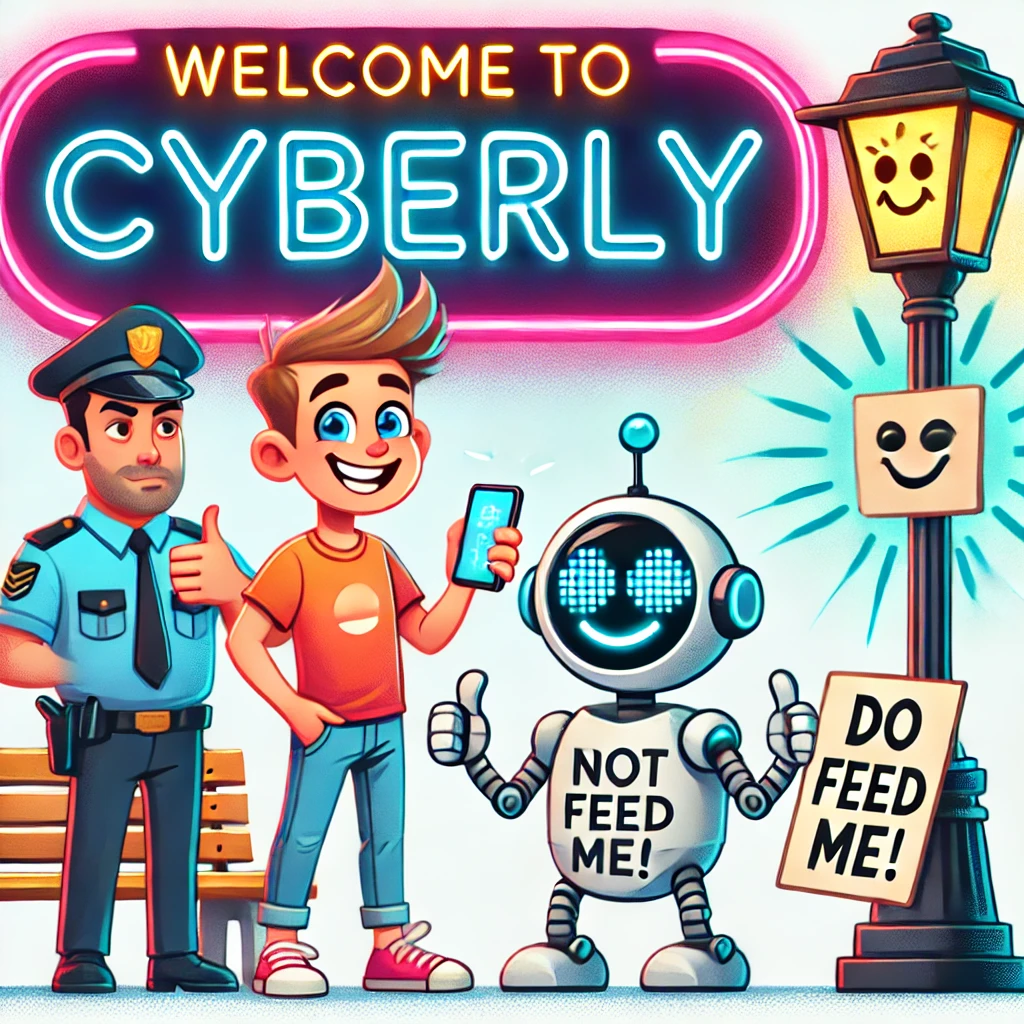
The Case of the Missing Context
Teaching digital forensics should feel exciting. Every device holds a secret. Every timestamp tells a story. But somewhere between the lecture slides and the lab sheets, the spark can fade. Especially when the case is too real.
We rely on scenarios. It’s how the field works. Something happened. Somewhere. To someone. With some bit of tech. But real cases come with real people. And that brings trauma, privacy, legal knots, and the occasional angry message about using anonymised screenshots in class.
To teach it properly, you need context. Not just files in a folder. A world. You need behaviour, relationships, motive. You need that odd doorbell alert at 2am and a sync log that doesn’t quite match the alibi. The evidence has to make sense in the life it came from. And that’s hard to build without risk.
We tried real cases. Too sensitive. We tried writing fictional ones. Too flat. The tech didn’t behave the way it does in real life. Even when the idea worked on paper, students struggled. They saw tools, not tactics. Artefacts, not action. Logs with no logic.
Then there’s the emotional cost. Some topics are heavy. Recreating them for teaching, marking them again and again, doesn’t just take time. It takes something out of you. You carry it. Not because you’re not trained. Not because you’re not capable. But because repetition wears you down. And in this field, the lines between teaching and practice blur quickly.
We don’t talk enough about the mental load on staff. Our team are investigators as well as educators. We build these scenarios by hand. Run them. Support the students through them. Then mark fifty versions and quietly hope someone spots the timeline detail we planted three layers deep. It builds up. Especially when you’re also juggling live cases or keeping your own wellbeing stitched together with caffeine and good intentions.
At Sherfox Labs, we care about that. Fun is not a distraction. It’s a strategy. It lets us go deep without harm. It opens space for curiosity. That’s why we built Cyberly with humour baked in. It’s why we chase odd projects and odd questions. It’s why the idea of winning an Ig Nobel one day is not a joke, but a mission. Because this work is dark. And joy, when used well, is serious business.
We needed something safer. Something that felt real, but wasn’t. A city with evidence, clues, digital traces, and just enough oddness to keep things interesting. A place where forensic minds could learn, test, explore.
We needed Cyberly.

Clues We’ve Tried Before
It didn’t begin with a city. It started with one scenario. I was early in my career, writing case notes by hand and hiding stories inside binary thumbnail caches and quietly suspicious registry entries. I built timelines, crafted chat logs and aligned time zones so everything made sense. The goal was simple. Make the artefacts behave like they came from a real life. Not neat. Not clean. Just human.
Students noticed. They spotted patterns in the browser history. Caught logins just before deletion. Unpicked clues I’d buried in places no one should look unless they’re truly curious. And when they connected the dots, I lit up. It made every long night worth it.
But building everything from scratch takes its toll.
That’s when I pitched the detective agency. One fictional team. One shared universe. My team loved it. We grew it together. There was continuity, narrative and reuse. We had characters. Backstories. Network maps with purpose. It helped. It made things easier. But it was still a lot to manage.
Then I moved to Southampton.
I was asked to build a new digital forensics capability from the ground up. This time, I had support. Infrastructure. Encouragement. And space. Space to be bold. Space to build a dream team. That’s when Sherfox began. And with it, something bigger than a lab.
Together, we built Cyberly.
We didn’t just design casework. We created a city. With regions, characters, systems and secrets. We talk about it like it’s real, because it feels real. We’ve debated whether VVI has its own firewall policy, whether the council Wi-Fi is filtered, and why the mayor’s office is suspiciously close to the train station.
With Cyberly, everything connects. Devices talk to each other. Histories build over time. A clue in one home might link to behaviour in another. It’s faster to build, deeper to explore and better all around.
We still build it by hand. Still obsess over timelines. Still craft datasets to reflect the real world. Automation is useful, but it leaves a trace. We want our evidence to feel like it came from a bad day in a real life.

Enter Cyberly: Fictional World, Real Learning
Cyberly is a city. A full fictional city with infrastructure, characters, and more smart tech than is strictly sensible. It has tangled timelines, overlapping networks and just enough misbehaviour to keep any investigator on their toes.
It began as a teaching tool but has grown into a living world. Every new case lands in a place with rules, history and digital memory. Familiar devices misbehave in familiar ways. Washing machines sync data they shouldn’t. Laptops vanish and reappear in odd places. It feels real, because it’s built that way.
We don’t start from scratch. New evidence slots into existing places. One city, many stories. That layering lets us go deep. Context builds up. Complexity comes naturally.
Because it’s fictional, we can push things further. No trauma. No risk. Just rich, believable data crafted to behave like the real thing. Logs that make sense. Timelines that tell a story. Artefacts that reward the careful.
Cyberly supports students, practitioners and policymakers alike. It’s consistent, flexible and safe!!!
… And yes, it’s fun. Mystery helps people learn. And Cyberly is full of it.

Inside the Tech-Crime Kingdom
Cyberly!

Founded in 1842, Nestled in the heart of England, Cyberly began as a quiet town with a penchant for innovation, a deep love of tea, and an unusually high number of suspiciously clever cats. Originally a hub for eccentric inventors and experimental gadgeteers, Cyberly’s transformation into a cutting-edge digital powerhouse was accelerated by the establishment of Villainous Ventures Inc. (VVI) (a shadowy organization that claimed to be a “consultancy” but was, in reality, a hive of mischievous tech masterminds). While some say Cyberly’s rise was purely organic, others whisper of VVI’s “unofficial contributions” to the town’s vast data infrastructure, experimental AI systems, and highly unpredictable autonomous teapots.
As Cyberly’s reputation for digital wizardry grew, so did its influence on cybersecurity, digital forensics, and ethical hacking. But where there are villains, there must be heroes. Enter the B.Y.T.E. Detective Agency, a fearless group of cyber investigators dedicated to solving the most perplexing digital crimes, from rogue AI conspiracies to smart fridge extortion rings. Operating from a high-tech but delightfully cozy HQ, the agency quickly became the UK’s most formidable force in digital sleuthing. Working alongside elite forensic specialists, law enforcement, and academic researchers, B.Y.T.E. turned Cyberly into the epicenter of cutting-edge investigations, all while ensuring that no bit of data went unexamined and no cybercriminal went unpunished.
Today, Cyberly stands as a beacon of cyber excellence, where students, academics, and law enforcement work side by side to push the boundaries of security and forensic investigation. Under the watchful eye of Mayor Dina Brave, the town continues to embrace the latest in technology, while remaining ever-vigilant for the schemes of VVI and the elusive Prof. Marmalade. Whether it’s protecting digital evidence, training future cyber defenders, or just brewing the perfect cuppa, Cyberly remains a town where tech meets tenacity, and occasionally, a dramatic explosion or two.
Cyberly Chronicles News
From fearless reporters on the ground to those keeping an eye on the ever-changing digital landscape, our team is dedicated to bringing you the latest scoops, storms, and scandals. Whether chasing breaking stories, predicting the unpredictable, or filtering signal from noise, they work around the clock (and occasionally against the laws of physics) to keep Cyberly informed.
No story escapes the ever-watchful gaze of The Great Algorithm, Cyberly News Network’s omnipresent, all-knowing AI, which sifts through petabytes of data, social feeds, and encrypted whispers to deliver breaking news before it even happens. While invaluable for real-time reporting, The Great Algorithm is not without bias, sometimes prioritizing stories about sentient vending machines over actual government scandals. Despite its quirks (and occasional apocalyptic predictions), Cyberly wouldn’t be the same without its ever-vigilant, mildly ominous digital journalist.

B.Y.T.E Detective Agency

Welcome to B.Y.T.E., where tradition meets technology in the heart of Cyberly. Led by the esteemed Lord Pixelington, our agency specializes in untangling the web of mysteries with a blend of old-school detective savvy and cutting-edge tech.
At B.Y.T.E., we believe every case is a puzzle waiting to be solved, and no villain, not even the notorious Professor Marmalade of Villainous Ventures Inc., can outsmart our collective wit. Our team of tech-savvy sleuths and gadget-loving geniuses are on a mission to safeguard Cyberly’s future, one byte at a time.
Villainous Ventures Inc!
Villainous Ventures Inc. (VVI) claims to be a consultancy. The kind that pops up overnight, registers seventeen shell companies before breakfast, and somehow ends up on the council’s Innovation Advisory Board. In truth, it’s a shadowy, chaotic organisation rumoured to have its servers buried deep beneath Biscuit Borough and its fingers in nearly every system in Cyberly. From their glass-walled HQ, they conduct experiments of uncertain legality and even less documentation, often under the vague heading of “urban optimisation.”
Led by the flamboyantly mysterious Professor Marmalade, VVI operates with the flair of cheesy cartoon villains who are just a little too proud of their plans. They monologue. They broadcast teasers. They leave calling cards. And somehow, despite the city’s best efforts, they always seem to get away in the final moments of every investigation. Her team of cunning cohorts includes digital illusionists, crypto-conjurers, and hardware tinkerers who, oddly enough, bear more than a passing resemblance to the staff and friends of Sherfox Labs. No one can prove the connection, but let’s just say the resemblance is uncanny. Suspiciously so.
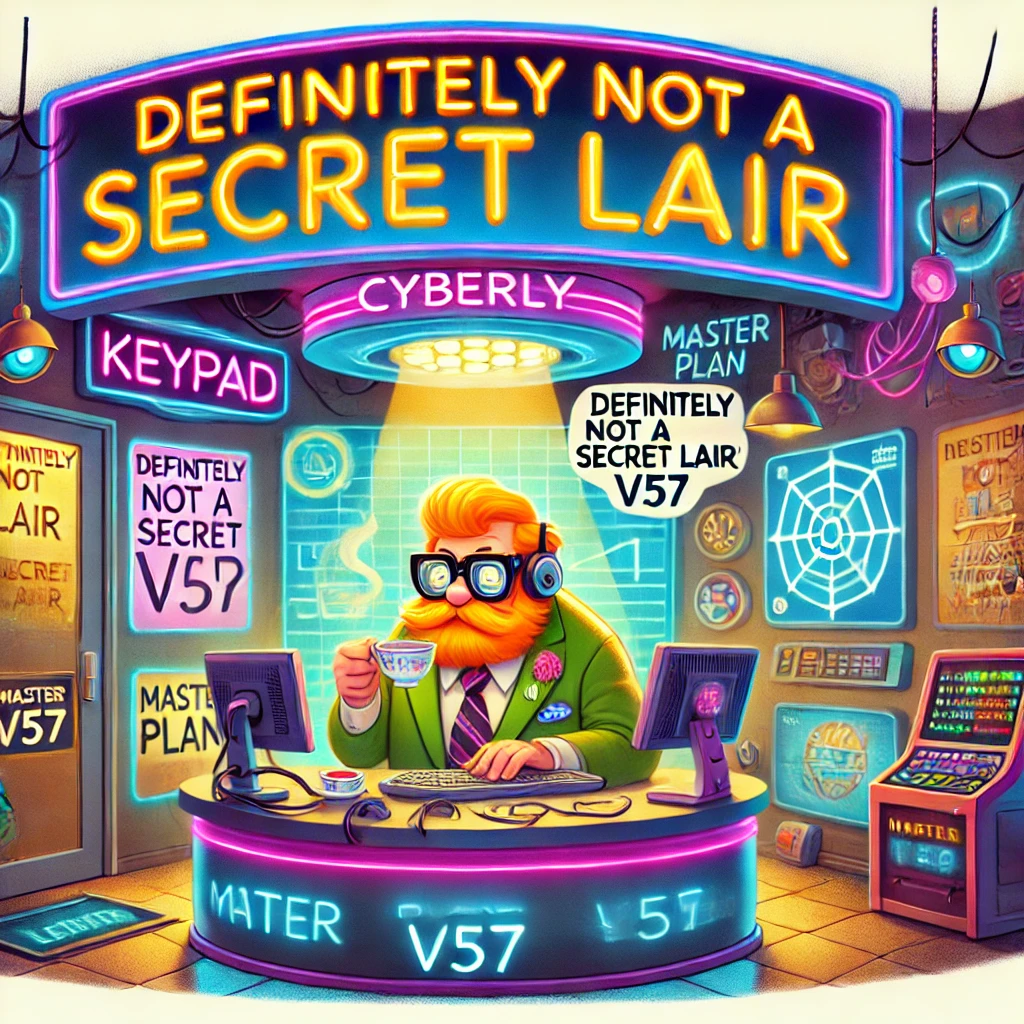
404FM: Cyberly Radio – The station not found!
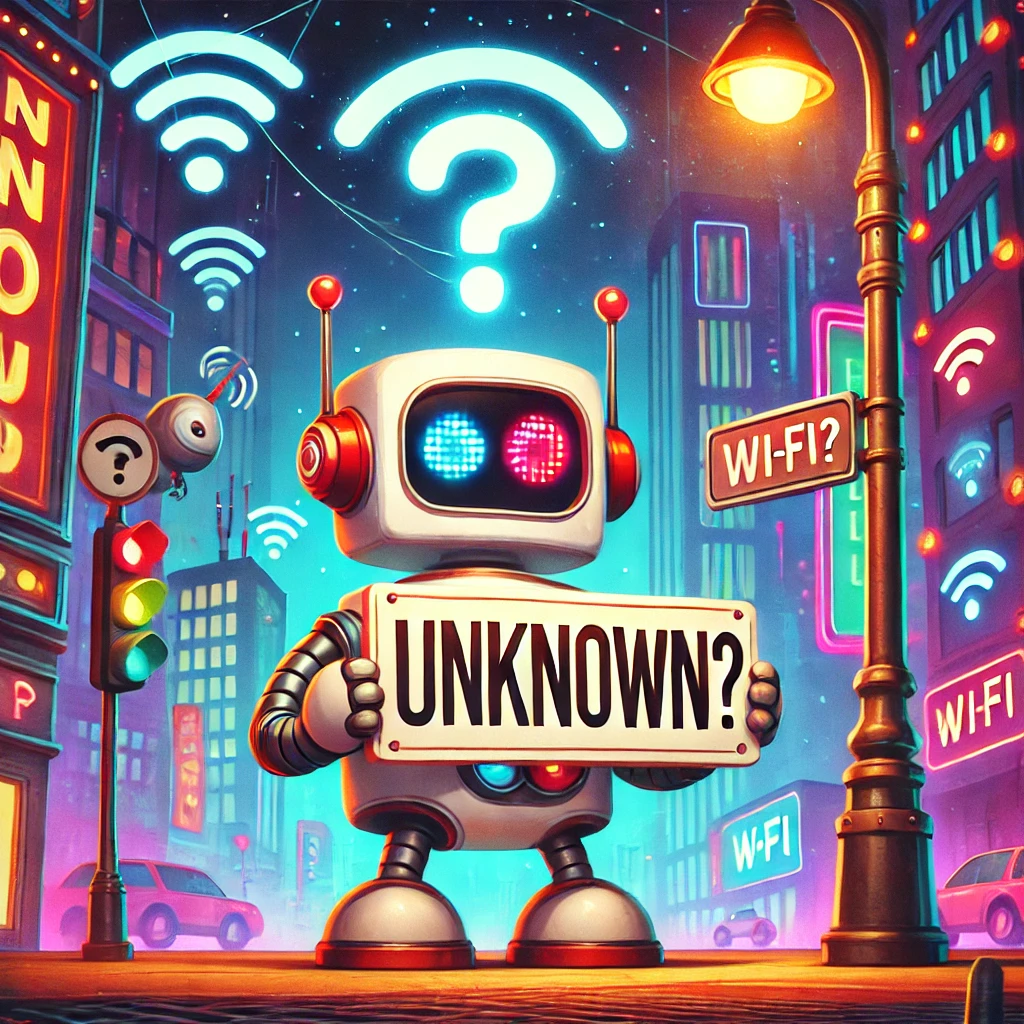
404 FM is Cyberly’s beloved, barely regulated radio station. Broadcasting on all known frequencies and several unknown ones, it’s home to the city’s finest selection of glitchy bangers, retro remixes, and local chart-toppers that could only be described as “cyberly.”
Between the music, listeners are treated to wildly inaccurate news bulletins, overacted adverts for clearly suspicious services, and live call-ins from residents reporting smart bin conspiracies or asking if their fridge should really be making that noise. No one’s quite sure who runs it, but the station has become an integral part of daily life in Cyberly, the soundtrack to packet captures, metadata mishaps, and late-night USB recoveries.
Playing Detective: How We Use It
Cyberly is more than a setting. It is a toolkit. A platform. A city we return to again and again to teach, train and test.
We have templates for different parts of the map. Prebuilt layouts for regions of Cyberly that we can drop into a lesson, an event or a dataset. Each one is ready to host new problems and old habits.
Three main websites form the public face of the city. Cyberly Chronicles is our news outlet. BYTE is the detective agency where investigations unfold. Villainous Ventures Inc is the kind of consultancy that should probably be on a watchlist.
The physical scene room acts as VVI headquarters. It is a teaching space, a testing ground, and sometimes an escape room with questionable ethics. It lets learners step into the case. Not just see the data, but live inside the story.
We have a growing library of datasets. Every case comes from somewhere in the city. That includes structured evidence sets, fake business networks, sync logs, digital debris and even corrupted washing machine timelines. The Cyberly corpus holds all of it.
We also run a dedicated Moodle site for Cyberly. It hosts self-paced learning, outreach tasks, H5P activities and branching storylines. We use it for continuing professional development, public engagement and everything in between.
Cyberly supports our MSc teaching. It underpins research. It fuels public engagement. We use it in outreach, in staff training and in those moments where we need to show how real digital evidence can behave.

What the New Recruits Think ….
The people of Cyberly, real and fictional, have opinions. Lots of them.
We’ve used Cyberly in outreach events, CPD training, and our MSc teaching, and every time, something clicks. Learners engage more. They ask better questions. They don’t just do the task, they dive in. Some even forget it’s fictional.
Students email B.Y.T.E. detectives mid-case to ask for evidence updates. CPD professionals stay behind after sessions to talk about suspicious routers they saw in the background of scenes. We’ve had legal specialists ask if VVI is hiring, and one practitioner demanded to speak to the mayor about data governance.
And yes, people are very invested in the slow-burn romance between Clipboard and Fluffy. “Do they have matching passwords?” one student asked. “Are they allowed to be together under VVI’s staff policy?” asked another. The answer is of course, “It Depends!”
We’ve had feedback like:
- “This is the most fun I’ve had in CPD.”
- “It actually stuck!”
- “VVI’s guide to accessing the doorbell made the approach easy, and feel like evil genius”
- “My student asked me if Fluffy was okay after you left.”
Cyberly makes learning stick. It makes hard things easier to talk about. It gives people permission to get curious …. And it turns out, curiosity is a very good teacher.
Professor Marmalade, Head of Villainous Ventures Inc, issued a formal statement about the rising popularity of BYTE’s new recruits: “Unacceptable. Utterly unacceptable. These so-called ‘students’ are meddling, competent, and dangerously observant. One of them spotted the encrypted teapot logs in under seven minutes. Seven! I’ve had interns who couldn’t find the on-switch in that time. If this continues, I may be forced to… educate them myself.” She was last seen cackling near a whiteboard marked Phase Four: Dancing Kettle Chaos.
Cyberly 2.0: Where We’re Headed
Cyberly keeps growing. The next step is distance learning. Self-paced adventures for students, professionals and anyone who fancies solving a mystery on their lunch break. These versions will run quietly in the background, always ready, always just a little bit strange.
We’re also expanding public engagement. More talks. More games. More chances to confuse your local councillor with questions about teapot metadata.
Sarah and Smudge are writing a children’s book based on their time in the city. It’s full of puzzles, gadgets and gently suspicious bedtime routines. The goal is to spark curiosity early and give the next generation of investigators a world to grow into.
Meanwhile, the scene room is being improved! Over summer it will gain yet more new sensors, new secrets and a few surprises we probably shouldn’t talk about yet. There will be anti-forensics. There may be decoy devices. At least one activity is being designed specifically for dogs.
Cyberly 2.0 is on the way. Expect nonsense. Expect evidence. Expect fun!!!!!
Fancy a Cuppa and a Chat?
Cyberly is our intellectual property. The world, the characters, the datasets and materials were created by Sherfox Labs. We built it, we maintain it and we keep a close eye on anyone trying to hack the mayor’s firewall.
But we didn’t build it to keep to ourselves. We’re open to collaboration. If you’d like to use Cyberly in your own teaching, research or training, just get in touch. We’re always happy to talk about shared projects or new ways to explore the city.
For CPD opportunities, you can visit our course page or contact us directly. For public engagement, guest talks or something a little bit unusual for your event, let us know. We’ve turned up in schools, courtrooms, museums and once, unintentionally, in someone’s national grant pitch.
All the key websites are below.
Just please don’t side with Villainous Ventures without a proper risk assessment.
- CPD Course List –Sherfox CPD Course List
- Contact Me – Professor Sarah Morris
- Cyberly Chronicles News – Cyberly Chronicles News
- B.Y.T.E. Detective Agency – B.Y.T.E Detective Agency
- Villanious Ventures Inc – Villainous Ventures Inc